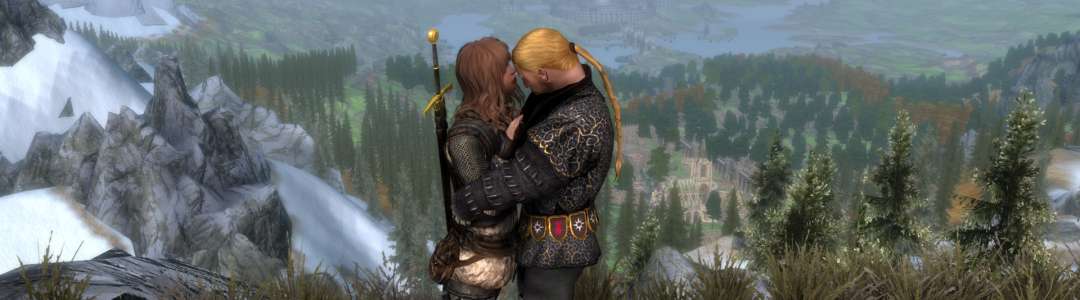
Turdas, 25th Last Seed, 4E 202
Those who could attend had been teleported into Akashima, one by one, by Shije. The gravity of the situation curbed his sarcasm, and he was both respectful and courteous to the attendees. He then apologised for his need to be elsewhere and vanished.

Grandmaster Mitsumori observed the attendees from his raised dais. Seated to his right was the Master of Arms, Lord Yatahashi Mori. Vayu’s immediate superior, Lord Raikou, stood next to Lord Yatahashi. Next to Raikou was Silah. Lord Akatosh had allowed her to change her avatar from the ghostly figure to one of flesh and blood.

To Grandmaster Mitsumori’s left stood Master Mage Merria and Psijic Monk Nxendia.

Mitsumori let the attendees mingle for a few minutes before signalling Yatahashi. The Master of Arms then stood, held out a small gong and hit it three times before sitting down again.
The room fell silent, and all eyes turned to Mitsumori.
“I welcome the friends of Valdr Septim to Akashima, home of The Dragonguard. Many people have been investigating the events of two weeks ago and, in turn, have spoken with the representatives here. Inevitably, some reports may be lengthy and, in some cases, involve complex metaphysical concepts. I ask that we allow each representative to deliver their report in turn and without interruption. After a representative has finished, questions and discussion can commence. There is no time limit, and we will not commence the following report until all those present indicate they have the knowledge they seek. I will start with the basic events in the aftermath of Valdr’s disappearance. Each of these events will be discussed in more detail by the relevant representative.
Two weeks ago, Valdr unfurled an Elder Scroll called, in Tamrielic, The Manuscript. The reasons he deemed it necessary to read The Manuscript are understood, and I doubt anybody here disagrees with his decision.
The Elder Scroll was not designed to banish the entity called Longwang, who we know was Dagoth Ur. It was designed to trap the reader. What that trap did to Valdr is still a matter of conjecture. He said, just before he vanished, ‘Trap! Multiple timelines! I am sorry…’ That deliberate clue left by Valdr has guided much of our investigation.
Naturally, in the immediate aftermath, all eyes turned to Emperor Temujin-Xhik. Had Longwang compromised him? Was he working for some other sinister superior? Or did he desire harm to Valdr for personal reasons?
They were valid questions for a valid suspect. However, Emperor Temujin looked as shocked as everybody else at the turn of events. Then he staggered forward two steps, eyes bulging, and dropped dead.
Across Nirn, many Dov became insane. Some flew in random patterns. Some sat and roared without end. Fortunately, none of them resorted to base instincts or violence. Some Dov retained enough common sense to fly over areas of population and assure people they were not in danger from other Dov.
Strange events occurred across Nirn as timelines mingled. They are too numerous to mention and were mostly harmless. The report of a Numidium in Solitudes’ bay was the most alarming, but it vanished as a quickly assembled armada sailed towards it.
Mage Endyval was transported to The Imperial City, where a Military Tribunal was hastily convened. He did not deny the charges and was beheaded a week ago.
Nirn is in political turmoil. Hundreds of millions are panicked and afraid, with no answers from their deities or leaders. Old and new animosities have been fuelled by suspicion, superstition and people taking advantage of the chaos.
Those investigating Valdr’s disappearance must now concentrate on helping the people and preventing further harm. So today, we will summarise what we know and decide how to proceed with minimal resources.
Lord Raikou will now report on the preliminary findings concerning The Manuscript and Valdr’s fate.”
Raikou’s deep and resonant voice demanded attention. His stare, complemented by a third eye, was piercing. Students of his, including Vayu, soon learned to listen and pay attention when the Kamal spoke, for his temper was great.
He began, “It has been two weeks since Wulf vanished. We have had to be careful about revealing the situation. Still, amongst those who have aided us are some of the keenest minds on Nirn.
We are going to hear a lot of speculation today. Valdr would not care, for speculation often leads to fact. It is only when it is presented as fact that our missing friend growls and berates others.”
That observation drew laughter from all attendees, including Rigmor, who had found little light amongst her dark thoughts.
Raikou continued, “Dragonlord Vayu summoned another squad to take care of Mage Endyval. Then he summoned Sinje, who, in turn, brought me to the throne room of Zei’Vaaz-Ruhk. Whilst awaiting me, Vayu summoned Dragonlord Celestine. She was busy examining the corpse of Emperor Temujin-Xhik when I appeared. Sinje had briefed me on the situation, so I was content to observe the others present and await Celestine’s conclusion.
Zi-Khuliin Ushevi Aina must have had her suspicions because she was already examining the walls of the throne room before Celestine announced her findings.
Temujin had been struck on the neck by a blow dart. Its tip had been coated with Jarrin Root Poison, and there was no hope of survival. Vayu’s squad joined Ushevi in the examination of the throne room walls. A murder hole was soon located.
Valdr had warned the Palace Guards that there was a traitor amongst the highest-ranking officials attending Temujin. That is how Marks were placed in the castle’s courtyard that led to the first assault. We cannot assume all those opposing Valdr were puppets or agents of Longwang. The mystery of who attacked our previous headquarters remains.
I examined The Manuscript. It was blank, but many who try to view an Elder Scroll see nothing. Dragonlord Vayu then made a relevant point. Valdr has encountered Elder Scrolls whose contents had been altered. They were the ones required to decipher ‘The Tyranny of the Sun’ prophecy.
Valdr did not believe Arch-Curate Vyrthur had the skill or knowledge to alter the Elder Scrolls. We did not know if The Manuscript had been altered. We knew Moth Priest Dexion Evicus was currently studying various Elder Scrolls that Valdr had donated to The College of Winterhold. We took The Manuscript to him and asked him to study it.
As soon as Dexion held The Manuscript, he announced, “This is not an Elder Scroll. There is no provision for a conduit to read it.”
Dexion then unfurled the fake Elder Scroll and gasped, ‘By all that is sacred! Where did this come from?’ I told him Valdr found it in Akavir. That was enough information for Dexion, and he did not push for more.
Dexion explained that countless people, and gods, have tried to dismantle an Elder Scroll and failed. Almost as many have tried to replicate the transparent, flexible material on which the information is inscribed. Whoever created the fake Elder Scroll had skills not thought to be within the domain of mortals or gods.
When I asked about the Elder Scrolls needed for The Tyranny of the Sun prophecy, he said they were altered, not entirely written from scratch.
The metaphysics of Elder Scrolls is incomprehensible even to the greatest mortal mage. We do not believe any god, Aedra, or Daedra can create one. Altering one or two may be possible, but not by Arch-Curate Vyrthur. He must have had assistance.
Similarly, we doubt Dagoth Ur has the expertise to create a fake Elder Scroll. We also doubt he could create a dweomer that recognises and captures an Aedric Dragonborn. He, too, must have had assistance.”
Rigmor said, “Molag Bal would benefit from both schemes! Oh, pardon me for interrupting.”

Despite his reputation, Raikou is kind-hearted and understands how Valdr’s disappearance was affecting Rigmor. He nodded in acknowledgment, then continued.
“Countess Rigmor is correct. Lord Bal would benefit from both schemes, which leads us to further speculation.
Valdr questioned Dagoth Ur’s ability to leave The Void. Many Daedra, including the Daedric Princes, have an Anamnetic-Anchor. They are called many things, including Anamnesis, Animus Anchor, Return-Point, Refraction-Point or simply Anchor. However, Anamnetic-Anchor is the Psijic Order’s name for the metaphysical concept, so we shall use that terminology.
Aedra and Daedra are ontologically anchored to their native realms and cosmological roles. I can see from the blank, and stunned looks amongst you, that was pure mumbo jumbo.”
Rigmor knew Raikou was deliberately using Wulf’s terminology. This meeting was to share knowledge amongst those present and to give her some understanding of what happened to her beloved.
Raikou said, “We can only provide brief explanations of some metaphysical laws. Aid will be given to those who wish to pursue a greater understanding.
When certain entities are killed, banished, or scattered into The Void, their Animus, also known as et’Ada-essence, obrix or refraction, is pulled back to its origin. Their form re-coalesces over time. Their Anamnetic-Anchor is the metaphysical force that pulls them back from The Void.
The Anamnetic-Anchor for mortals is The Soul-Stream. That is not The Void, although many scholars fail to differentiate between the two. I know that Valdr does not bother mentioning The Soul-Stream when discussing fundamental metaphysics to people.
If a mortal’s soul ends up in The Void, they have no way of returning to The Soul-Stream or Nirn. Valdr managed to return to Nirn because he has two Anamnetic-Anchors. One is his physical body. That is a function of his Dovah Soul. The other Anamnetic-Anchor is Countess Rigmor.”
Rigmor gasped but was left speechless by Raikou’s claim.
“Dagoth Ur was a mortal, so his Anamnetic-Anchor was The Soul-Stream. That was until he was exposed to the power of Lorkhan’s Heart. That acted as a synthetic anchor. While it existed, Dagoth Ur’s soul could not return to The Soul Stream. It could only reform around The Heart.
When The Heart was destroyed, Dagoth Ur’s soul should have ended up in The Soul Stream. For reasons we do not know, it ended up in The Void. That is not uncommon, and those who travel with Valdr would have heard him tell enemies he will send them to The Void.
Mortal souls cannot reach the Anamnetic-Anchor of The Soul Stream when in The Void. Therefore, Dagoth Ur’s soul could not escape. Another entity must have rescued him from The Void.
The rescuer would need to provide an external anchor or retrieval vector. Daedric Princes can do this by imposing their realm’s signature, Obrix, onto a soul. Other beings can use other methods.
Remember, what follows is speculation based on logic. We have no proof and no Valdr’s intuition to guide us.
Molag Bal is often referred to as The God of Schemes and Prince of Plots. Of all the Daedric Princes, he has hatched the most schemes to bypass The Liminal Barrier and enforce his will upon mortals. Bal would want Dagoth Ur to interfere with Akavir politics for similar reasons Mage Endyval meddled. Bal could recruit many followers not to defend Tamriel, but aid in its defeat or some other scheme. The Way of the Coil hides the origins of Tsaesci vampirism. It seems a natural adaptation by the species, but is it? Whenever vampirism occurs, it is wise to suspect Bal’s possible influence.
Valdr did not have a chance to investigate those who attacked our previous headquarters. However, the fact that some of them were infected with Sanguinare Vampiris suggests a possible connection to Molag Bal. It is reasonable to assume Bal found another way to transmit vampirism amongst the Tsaesci. There is no logical reason for it to develop naturally.
After lengthy discussions with many educated people, we believe Molag Bal was manipulating Dagoth Ur. Gathering more devotees was not the principal reason for this manipulation. Snaring a Dragonborn was. Not a Tsaesci version, such as Zi-Khuliin Ushevi Aina, but one with an Aedric Dragon Soul such as Valdr.
So, we believe that Valdr has been taken to Coldharbour by Molag Bal for reasons unknown. Certainly not to kill him, and the Daedric Prince would have little chance of coercing him or placing an ensorcellment upon him.
We are sure that the Coldharbour of this, the Primary Timeline, does not contain Valdr. The presence of a powerful Aedric Soul in Oblivion is not something immediately hidden from other Daedric Princes. We know Bal has ensnared Dov in the past because other Daedric Princes told mortals. They knew of Miraak’s imprisonment by Hermaeus Mora but assumed he had been killed when, in fact, he was placed in stasis. Lady Azura is attuned to Valdr’s soul and would have detected his presence in a realm of this timeline’s Oblivion even if hidden a split second later.
Priestess Aranea Ienith asked Lady Azura and was told that Valdr does not exist in this timeline’s Coldharbour.
Molag Bal, like all the gods, is at the mercy of the metaphysics of the Aurbis. Something went wrong when Valdr triggered the trap. We believe Valdr is in Coldharbour, but in a parallel timeline.
This hypothesis may seem like a massive leap in logic and the worst kind of speculation, but more than one mind reached the same conclusion before discussing it with others. I call upon Dragonlord Vayu to expand upon our reasoning, but first, are there any questions?”
- Rigmor: I am at a total loss as to how parallel timelines work. Do people have multiple souls? Do our gods know what is occurring within those parallel timelines?
- Raikou: Psijic Monk Nxendia will attempt to explain the metaphysics involved after Vayu has concluded. I ask that you be patient until then, Countess Rigmor.
- Rigmor: Okay, I expect all will become clearer as we go.
- Raikou: That is the hope.
No further questions were forthcoming, so Vayu proceeded with his findings.
“Zi-Khuliin Ushevi Aina’s memories of past events were clarified after the banishment of Longwang’s avatar. She told us that, several times, the monk who read The Manuscript two hundred years ago and Valdr were the only ones who could unlock some doors or dispel specific magical barriers. Valdr had mentioned this to me, and at first, we found it interesting but could not place any significance on it. However, we started to suspect that everything was designed to confirm the presence of an Aedric Dragonborn for sinister, not altruistic, purposes.
We knew parallel timelines were involved because another Nerevarine was present. Valdr had detected the same feeling of wrongness that surrounded The Nerevarine’s sarcophagus when he was near the monk’s sarcophagus. Therefore, the next logical step was to investigate the monk. The sealed sarcophagus was inside Takamaro Kofun.
That ancient temple was full of undead that Longwang had unleashed after speaking to Valdr. Fortunately, Valdr had set a Mark just outside, and he and Ushevi avoided having to fight their way to freedom.
I summoned my squad and, together with Ushevi, we fought our way to the sarcophagus. The Zi-Khuliin mentioned that Shades were now protecting the sarcophagus, so I summoned more Dragonguard mages. Together, they formed a barrier strong enough to keep the Shades at bay. Silah joined us and confirmed the disturbance Valdr had sensed was the same as that around the sarcophagus of The Nerevarine. She concluded that the two came from the same parallel timeline.
On returning to Aurane, I informed Countess Rigmor of what we discovered. Hopefully, I am not about to reopen old wounds.”
Rigmor smiled at Vayu and replied, “I knew it was not my beloved, Vayu. I was more upset for those close to the Wulf within that coffin. They would never know his fate.”
Vayu continued, “I broke the seal on the sarcophagus, and several of us removed the lid. The body was wrapped in white linen, but I knew what I would find beneath. Valdr is not the tallest person we have encountered, but he is larger than most. Removing the linen revealed a familiar face. The beard and hair were different, and there was a large scar on his left cheek, but the monk was Valdr from a parallel timeline.
Logic took a break as I wept over my friend. It was not the Valdr I knew, but that mattered little. The other Dragonguard also fell apart at the sight.
Ushevi also cried, but she explained she had never experienced the communal love that Valdr has.
Valdr was puzzled why he kept seeing himself in the ethereal visions, even the one The Eye provided. Now we had an explanation. The monk might not have been wearing Valdr’s armour, but he was seeing himself.
Around the monk’s neck was an Amulet of Stendarr. Not the normal one that most Vigilants wear, but one that designates the rank of Vigilant Paragon. For those not familiar with Vigilant ranks, there are eleven warrior ranks divided between three tiers, namely Recruit, Full and Senior. Above them are three ranks within The Keeperate.
The eleventh, and highest, warrior rank is that of Paragon. That title is reserved for those who have displayed significant acts of mercy or Daedra slaying. So rare is it that at any time, it would be unusual to have more than three or four Paragons in existence.
Paragons are rarely risked in routine duties. They are reserved for crises where the risk to their lives is deemed necessary. The monk had earned Paragon rank, as would Valdr if he were a Vigilant.
On the back of the amulet was an inscription that read, ‘Vigilant Paragon Ulfr. Tirdas, 23rd Evening Star, 4E 201.’
There was no Elder Scroll interred with Ulfr, but there was a sealed box inscribed with the name Valdr Septim. The box seems solid and seamless and is about the same size as the pages Valdr uses for his journals.
I resealed the sarcophagus and performed Arkay’s Rites. We then hastily exited Takamaro Kofun.
Upon returning to Skyrim, I conferred with Keeper Carcette about the inscription on Ulfr’s amulet. She said the date is when the Archkeeper approved the rank. She did not understand why one name was inscribed. Tradition dictates that a full name is used. Families display warranted pride when one of their kin is promoted to Vigilant Paragon. Keeper Carcette is aware of Valdr’s disappearance and did not pry further.
I showed Miraak the box. He said it was Blood Sealed and could only be opened by Valdr. We have kept it here, for it is the duty of The Dragonguard to protect it.
That is all I have to say. Are there any questions?”
- Baa’Ren: My friend, does the name Ulfr have any relation to Wulf?
- Vayu: Yes, it is ancient Norse from the time when the Atmoran first arrived in Skyrim. Like Wulf, it means wolf.
- Rigmor: It is too much like Ulfric for my liking.
- Vayu: The ‘ic’ at the end means arsehole.
- Rigmor: Yeah, right. Pffft!
- Serana: Vayu, did you inspect The Nerevarine’s body?
- Vayu: No. Nobody knows what he looks like, and there was no purpose in doing so.
- Serana: I am wondering why he and Ulfr died.
- Vayu: We think Ulfr was not suitable for Molag Bal’s purpose and was killed by one of Longwang’s accomplices. We think The Nerevarine died from exhaustion exacerbated by the extreme altitude and thin air at The Eye.
- Serana: It seemed illogical that The Manuscript would banish Longwang for a set period.
- Vayu: If they wanted Dagoth Ur’s dweomer to wipe memories and recruit more devotees, then a span of time would have been required. An even number, two hundred years, made it more palatable to the layman and easier to accept. It also eliminated nearly all the Akaviri alive at the time of Longwang’s first visit.
- Rigmor: The two hundred-year gap meant fewer questions would be asked.
- Merria: Their plan worked, Dragonlord Serana, and illustrates how well thought-out Molag Bal’s plans can be.
- Serana: How did Ulfr arrive on Tenno Island?
- Vayu: We do not know. We do not know how or why he was cast at least two hundred years in his past. There are many questions we may never have the answer to.
- Rigmor: Accept some things as gobblygook, Serana.
- Serana: I am a mage, Rigmor. That is not so easy to do.
- Atheris: It is a skill I have had to develop in a relatively short period of time.
- Merria: Thank goodness, as far fewer inane questions have pestered me.
- Atheris: I love you too, Merria.
Laughter ended the questions, and it was Nxendia’s turn to speak.
“Souls are far more complex than the basic model Valdr uses with laymen. He spent considerable time studying them, and his innate abilities allowed him to grasp complex concepts quickly, while many intelligent people spend decades wrestling with them. I will explain the three parts of a soul, and from there, what happens within a parallel timeline will hopefully make more sense. The Anamnetic-Anchor Lord Raikou mentioned will be expanded upon.
I can see from furrowed brows and blank stares that the concept of three soul components is new to most of you.
A soul consists of Lifeforce, or, to use the correct metaphysical terminology, Animus. There are many other names for it, but let us stick to Lifeforce, as that is familiar to most of you.
Lifeforce comes from Aetherius, the realm of raw creation. It provides vitality, health, instinct, and magical potential.
The Lifeforce within mortals is finite and diminishes with age, exhaustion, and injury.
Any unused Lifeforce is returned to Aetherius upon death unless it is bound.
Lifeforce is unconscious. It is ‘the energy that lives,’ but not the mind.
Lifeforce can be consumed using a Soul Gem.
Lifeforce, or Animus, is the energy of life. It animates the flesh, fuels the soul’s connection to magic, and maintains the body.
When a mage casts a healing spell, they transfer Lifeforce from Aetherius to the patient.
The second part of a soul is Consciousness, or Anima, as it is called in metaphysics. As with Lifeforce, there are many other names used for this component of a soul.
Consciousness contains a structured pattern of awareness that forms over a lifetime.
It contains emotions, identity, memories, choices, and willpower.
Consciousness is indestructible but mutable.
A Soul Gem cannot consume it, and upon a mortal’s death, it will try to travel intact to the afterlife realm that resonates with its pattern. If there is no resonant afterlife, it will attempt to return to The Soul Stream. Both journeys can be prevented by beings such as The Ideal Masters.
All mortal souls, with a few exceptions, will return to The Soul Stream when the kalpa ends.
A mortal chooses their afterlife and creates the resonance through worship and actions. A Nord displaying valour can create resonance with Sovngarde if they so desire. Some Khajiit might create resonance with Moonshadow, Lady Azura’s realm. Mortals know what certain gods expect of them, so the resonance is guaranteed if they adhere to the dogma dictated.
Most of Tamriel’s citizens will create a resonance with Aetherius simply by not being an arsehole.
An exception I mentioned is when a soul is entrapped within a Black Soul Gem. If the Lifeforce within the Black Soul Gem is used, the Consciousness’s passage to an afterlife or The Soul Stream is intercepted by The Ideal Masters, and it becomes trapped within The Soul Cairn. Valdr has wisely banned the use of Black Soul Gems within The College of Winterhold.
Consciousness can be influenced, wounded, or fragmented by various means, including trauma, magical corruption, or Daedric manipulation.
Think of Consciousness as the ‘you’ that persists after death.
The third part of the soul is Echo. It is called Numen in metaphysics.
The Echo is what remains with a corpse, object, place, or relic.
It is the soul’s metaphysical afterimage or imprint.
The Echo is a static pattern left behind when the Anima and Animus depart the body.
It forms naturally during life as the soul continuously interacts with matter, magic, and memories.
The Echo does not think or feel and is not alive. However, it retains the soul’s metaphysical shape.
It contains all aspects of a living being’s identity, including species, powers, memories, and innate magic.
None of you are dribbling or fallen into a coma, so I assume this all makes sense so far.
This three-part soul model explains much that the simplistic two-part model cannot. For instance, how Alduin could reconstruct Dov.
The strength of an Echo varies greatly.
Most mortals have a weak Echo, and that is why many ghosts fade with time, corpses rot quickly, and necromancy only produces mindless husks.”
Rigmor giggled and said, “Zoombies! Oops, sorry again!”
“In his journals, Valdr mentioned your Khajiiti friend, Inigo, uses that term. Do not apologise for finding amusement amongst the darkness, Rigmor.
A powerful Animus or Lifeforce strengthens a mortal’s Echo developed in life. Mages, warriors, nobility, and other aspects can strengthen the Animus and, therefore, a soul’s Echo.
A strong Anima-Pattern is developed through intense will and clarity of self. That will also increase the Echo’s strength.
A traumatic death burns the imprint, the Echo, deeper. That is why some souls do not readily transition to the afterlife or The Soul Stream, and why spirits and ghosts linger at the site of death.
Any period spent undead increases the Echo.
A strong connection to a location can increase the Echo and even make it haunted, even if the mortal died elsewhere.
Widespread belief or fear of a mortal can increase their soul’s Echo. Potema is a good example of that phenomenon.
To summarise so far, what remains with a corpse is not Lifeforce (Animus) or Consciousness (Anima) but Echo (Numen).
When Valdr was killed by Tarrin Root Poison and swords to his vitals, Lady Azura did not fight to keep some part of his Lifeforce intact. She fought to protect his soul’s Echo from other entities that were seeking it. If they viewed his Echo, they could find him in other planes. Valdr was being hunted within The Void, and the god he encountered protected him. His body already acted as an Anamnetic-Anchor, for he is a Dovah. However, the entwined soul of Rigmor also acts as an Anamnetic-Anchor. The uniqueness of their connection allowed Valdr to return to Mundus when he found himself within The Void again. That occurred while closing the Oblivion Gate in Morthal. You figured that out at the time, Rigmor. Valdr did die, but he still escaped The Void.
I am digressing, but I knew Rigmor was puzzled by Raikou’s claim that she was also an Anamnetic-Anchor to Valdr. Now she can concentrate on what else I have to say.”
Rigmor said, “Thank you, Nexendia. That was proving a distraction. It is also disturbing to think I love a two-time corpse.”
Those around her laughed, but they were all aware of Rigmor’s concerns and could not tell her when Wulf would return, if ever.
Nexendia continued, “If you apply logic and the truth of the three parts of the soul, many other complex metaphysical phenomena become less gobbledygook and more common sense.
To start my explanation of parallel timelines, I must emphasise two facts.
Only one soul exists per mortal. It does not matter how many parallel timelines contain the same mortal.
Not every action creates parallel timelines. Valdr should have clarified that, and when he returns, I will give him an old-fashioned Psijic lecture and scolding. He always enjoyed those.
Parallel timelines are created after a Junction. The larger the Junction, the more parallel timelines are created. For instance, the establishment of Saint Alessia’s Covenant created thousands of parallel timelines.
Timelines branch when significant destinies diverge, creating a Junction. Yes, I know Valdr hates the concept of destiny. Too bad, for in metaphysics, it exists. A destiny is a possible outcome. If that outcome can no longer be achieved, destiny has changed.
When Valdr and allies defeated Alduin, it changed the destiny of every mortal and the future of this kalpa; therefore, it was a significant Junction, and many new timelines were created. That is one example of many Junctions created by Valdr.
Significant metaphysical forces colliding can cause parallel timelines.
A choice with world-shaping potential will create a Junction.
Many actions of The Divines, Daedric Princes or Tower-Anchors are Junctions.
An example of a Tower-Anchor Junction is when the climate of a region changes to suit the dominant species.
Aedric Dragonborn, such as Valdr, create Junctions by their very nature. To explain that, I would have to go in-depth about how different Valdr is from any other mortal, apart from Miraak, in a metaphysical sense. That is far too complex a subject for now.
The Valdr we know is of this, the Primary Timeline. Any other Valdr is a manifestation and shares his soul.
Every living mortal connected to Mundus has a manifestation created when a parallel timeline is created.
There is not an infinite number of parallel timelines, but by the end of a kalpa, there could be billions of them.
The end of a kalpa results in all timelines coming to an end. We might know the cause in the Primary Timeline. I suspect the end of a kalpa would come as a surprise to manifestations in other timelines.
Souls exist in Aetherius, whilst timelines exist in Mundus.
The single soul of a mortal projects a single thread of identity into each timeline.
The soul does not split or duplicate.
The soul does not experience events simultaneously.
Instead, the soul accumulates multiple narrative possibilities.
An analogy I like to use is this. The soul is an author. The timelines are drafts. Only one author exists, although many possible narratives exist.”
A few nodding heads told Nexendia that the concept was being understood. She was relieved, for it is difficult when all they have experienced is a singular, sequential timeline and one narrative. The lecture continued.
“Each kalpa, at Convention, Lord Akatosh imposes linearity. The first timeline created is this one, the Primary Timeline. It is fixed, foundational and binds kalpa to kalpa.
Lord Akatosh does not select the Primary Timeline. The metaphysics of the Aurbis does. If more than one timeline is created, metaphysics chooses the most viable and terminates the others.
The Primary Timeline become the ‘official’ record of history, souls, actions, afterlife, and consequences.
Other timelines are possibilities. They can influence relics, prophecies, and magical anomalies, but they are not permanent.
If a parallel timeline ceases due to its perceived Nirn or Mundus ending, or for other metaphysical reasons, nothing is lost, as the soul gathers all experiences from its threads of identity.
If an entity is attuned to their soul, this absorption of experience may lead to greater wisdom, a stronger sense of identity, prophetic awareness, and an intuitive understanding of choices. I have often wondered whether Valdr’s exceptional intuition stems from Lord Lorkhan granting him heightened awareness of absorbed experiences.
This gathering of experience explains why the concept of a set destiny trumps the concept of free will for some entities.
It explains how Elder Scrolls can record multiple outcomes without indicating which is relevant to the Primary Timeline.
Heroes often feel they were chosen. Perhaps that is a result of gathered experiences.
Dragon Break survivors often retain impossible memories. Events that did not occur in the Primary Timeline, but may have been within gathered memories.
Valdr has the opinion that Déjà vu’ is a manifestation of gathered memories intruding on the here and now.
Another important fact is this. Aedra, Daedra and other gods exist outside of linear time!
The Aedra exist in Aetherius, Daedra in Oblivion and some entities, possibly the god that Valdr met, exist in The Void. All three are outside linear causality.
Because of this, an Aedra or Daedra is only ever a single being, regardless of how many timelines exist. They do not branch, split, or have multiple versions.
So, what do the gods perceive?
They perceive timelines as parallel streams that include variations of mortal history. They do regard them as independent universes.
Therefore, a Daedric Prince, or an Aedra through emissaries, can interact with the Primary Timeline and parallel timelines. They recognise Junctions and the parallel timelines created. They are aware of collapsed or combined branches. They do this as easily as a mortal turning their head to look elsewhere. When I used that analogy, the smartarse, Valdr, said it was like us growing several heads and looking in different directions simultaneously rather than swivelling a single head. He earned a stint cleaning the privies for that, although he was correct.
And ladies, male Psijic Monks have no better aim than other males!”
More laughter. More relief from the worries that each person present has been dealing with.
“To the gods, all parallel timelines are part of a single metaphysical system. The et-Ada that became Aedric Gods understand this concept because they were created with the senses to handle this reality. I can only imagine a latecomer like Lord Talos has had to work hard to understand such a foreign concept to a mortal mind. Mind you, willing things into existence would be hard to accept as well.
Even though a god, Lady Alessia is not a Divine and would have less knowledge of what occurs in parallel timelines than Lord Talos.
So, you are all asking yourselves, how does worship work in a parallel timeline?
Another concept Valdr reluctantly had to accept is that a god’s strength is determined by prayer and the number of worshippers. He had to accept that fact even if it seemed illogical. The continuing attempt by The Thalmor to reduce Talos worship shows they fully accept the reality and are using it to destroy The Divines and Linear Time.
There are many names for this metaphysical law. The two most common are Mythic Inertia and Numinal Weight. Valdr hated both and stubbornly refused to use either. He suggested Mythic Mass, then collapsed in peals of laughter.
Valdr’s reasoning was this. He envisioned a god devouring prayer and worship like a glutton. After a cosmic burp, their Mythic Mass had increased. So, Mythic Mass is the term we use.”
Rigmor laughed and then broke down in heart-wrenching sobs. Wulf’s disappearance has caused great grief in many people, but all knew that Rigmor’s was unbearable.
Talking was postponed while Rigmor was comforted, and her pain shared. Baa’Ren-Dar let his daughter sob into his shoulder and let his own tears roll unabashed.
When Rigmor was ready, the lessons continued.
“We are getting into deep concepts that dictate what Wulf would experience in a parallel timeline. I think it is best at this point if I summarise. Anybody who wants further information can contact me later.
Gods react to events in each parallel timeline the same as they do for the Primary Timeline. Their decisions and actions are based on the reality of the timeline. They do not let the events of the Primary Timeline dictate their actions in a parallel timeline.
This ability means they might be aware of millions, if not billions, of different histories. Their strength in each timeline will vary according to the Mythic Mass they have in that timeline. The gods are making decisions at a rate and volume we cannot comprehend. Those of you who interact directly with gods must realise their one-on-one discussion with you is simultaneous with other innumerable decisions, actions, and interactions across multiple timelines.
This ability is gobblygook at its finest. Just accept the reality and do not hurt your brain trying to figure out how it is possible. The metaphysics of the Aurbis dictate these laws, not the gods.
If Valdr is in a parallel timeline, he will recognise that fact. He will avoid creating a paradox, for that would make the parallel timeline untenable and cause it to dissolve. If he is in a parallel timeline Coldharbour, he may face a Molag Bal with more or less power than in the Primary Timeline. He would be careful not to let Molag Bal know he was not of the timeline.
Within his realm, Molag Bal would recognise Valdr’s soul as that of an Aedric Dragonborn. He would not and could not know what timeline Valdr was from. To Bal, an Aedric Dragonborn was captured, so that part of his scheme succeeded. He would proceed with his plans based on that knowledge.
Valdr has the knowledge and skills needed to return to the Primary Timeline. None of us should doubt that. What we cannot predict is when he shall return, and how the experience may have changed him.
Vigilant Paragon Ulfr knew of Valdr. I assume the Blood Sealed box contains information a returned Valdr may need. Both would be aware of the dangers of paradoxes. I like to think they worked together to return Valdr to where he belongs. I would not be surprised if The Eye is involved in these events.
That is all I have to say for now. I have truncated my metaphysical lessons, as anything more might be interesting to some, but irrelevant to dealing with current issues. Are there any questions?”
- Granite: I have many, but I cannot decide which hurts more. Is it my brain or my empty stomach?
- Vayu: Do not worry, Granite. Apart from Silah’s explanation of the tangled timelines, the metaphysics is over.
- Baa’Ren: This one thinks dealing with the political aftermath is just as likely to hurt one’s brain as the metaphysics.
- Atheris: Can I hear thunder?
- Vayu: No, Atheris, that is Granite’s stomach rumbling.
- Atheris: Then we had better adjourn for food before he perishes.
Mitsumori signalled Yatahashi. The Master of Arms then stood, held out a small gong and hit it three times. This time, he did not sit down again.
Mitsumori said, “Let us have refreshments and privy breaks before Silah tells us about the knotted timelines and what we can expect going forward. We shall gather again in an hour.”
Knowledge is Power, it is needed to know What happened in order to bring about a solution. So many pieces of the puzzle without a clear picture to place it in the correct spot. Thank You Mark
The biggest delay in producing this entry was the need to create a cohesive set of metaphysics to allow Vigilant a place in the blog. I could not include it by ignoring the fact it is set in a parallel time stream where history is different. But I hate some of the McBridism’s that are not part of the written lore in any Elder Scroll’s game but have been used by mod creators. Much of it is hogwash, no matter how different you regard the Elder Scrolls universe. So ChatGPT and I took what metaphysics is within the games and made sure it could explain the events of Vigilant. I would test scenarios against the metaphysics and often get a result I was not expecting but lore friendly. That is why some of Wulf’s long held dislikes have to be accepted as metaphysical law. I have tried to reduce it to palatable, bite sized snippets in this entry and the next, but there will still have to be a lot of, “It happened… accept it… gobblygook” going forward. This set of metaphysics will also allow the events of the follow up to Legacy Of The Dragonborn to make sense in Wulf’s universe.
Another excellent presentation Mark, and, your most complicated to date. When one examines ” Faith “, the parameters and dictates are endless, and complicated. Your current offering displays this perfectly.
The SAGA continues………………………..
YEAH, I am a very happy chappy to see this up but it will a while before I get to read it. I have started reading these “new journals” again and I am upto the 25.9.24 so I have a while to go. Mark, you obviously have your mod set up and running Okay. Do you have different profiles to run experimental mod set-ups or you only have one?.
Mark, I hate you, yes H-A-T-E, to quote a young lass who said that to Wulf a couple of years ago because I still bloody well cry every time I play Rigmors’ song. It is the most beautiful song I have every heard.
I decided on a mod list and then tried playing through it. If I came across a problem there were decisions to be made. The one thing that has caused issues in the past is something embedded in saved games that makes the game unstable later on. So I ended up changing a few mods from my original choice and abandoned EMB and Community Shaders. I might return to Community Shaders at a latter stage but they removed support for particles and that seemed like a strange, arbitrary decision and made me wary. I think with ELFX and a few other mods, the graphics look great. However, parallax is a big improvement, and Community Shaders is the easiest way to support it. Replacing FNIS and Nemesis with Pandora was a good move and finally ditching AFT for EFF was a wise decision. Palaces and Castles has been dumped for a full JKrojmal (JK’s) solution. I tried the combined JK and P@C build but it was unstable. I have abandoned the NPC makeover mods I was using for a Pandorable, Bijin solution so people will look different, including most of the Dragonguard. A certain house near the Throat of the World has made a comeback but the Dragonguard will be scattered all over the place.
A certain house made a comeback??? I wonder which one that is? It is my main residence.
Why do you use EFF? (last updated in 2918) For the last few rebuilds I always use NFF and have had no problems. Updated October 2024.
Community Shaders but not all of the add ons, FDE for all the followers except Lydia, she has IFD, and Serana uses her dialoge-add-on SE mod and SkyChild to get rid of the potatoe heads.
Sorry, I meant NFF. I use Skychild and a Japanese mod I have been beta testing to replace the kids.